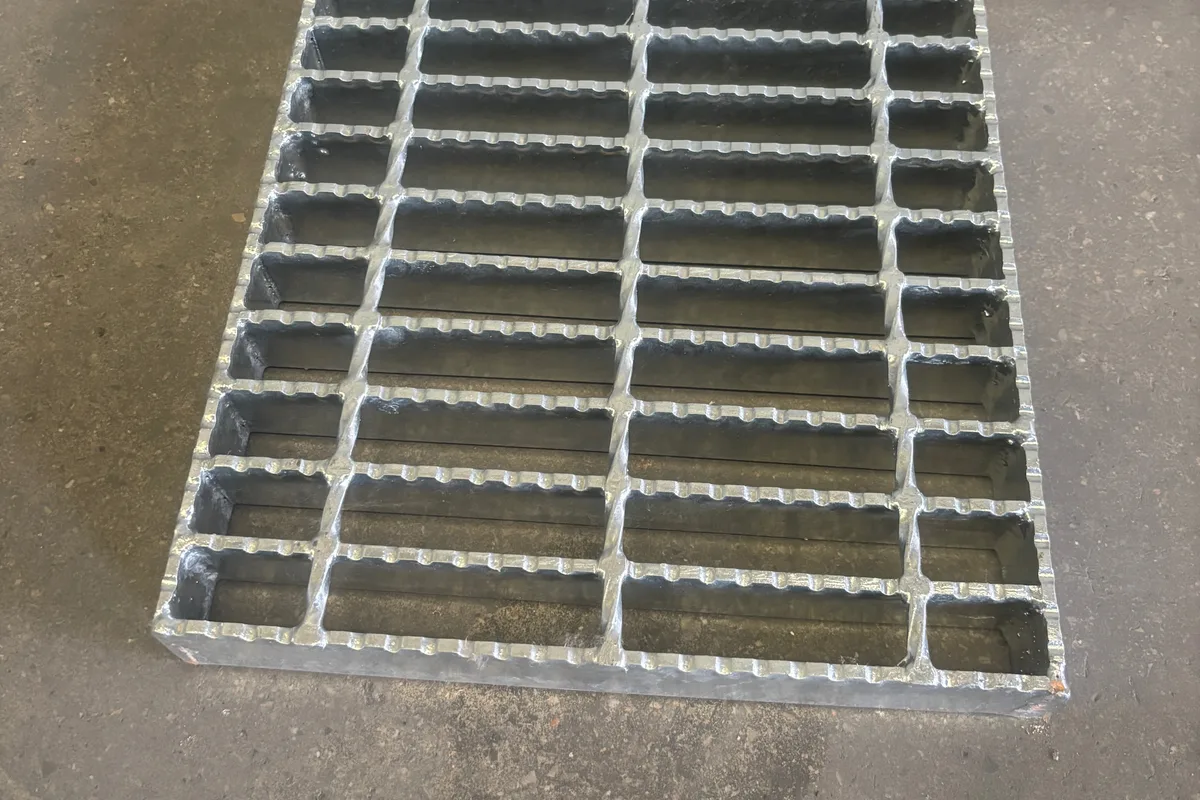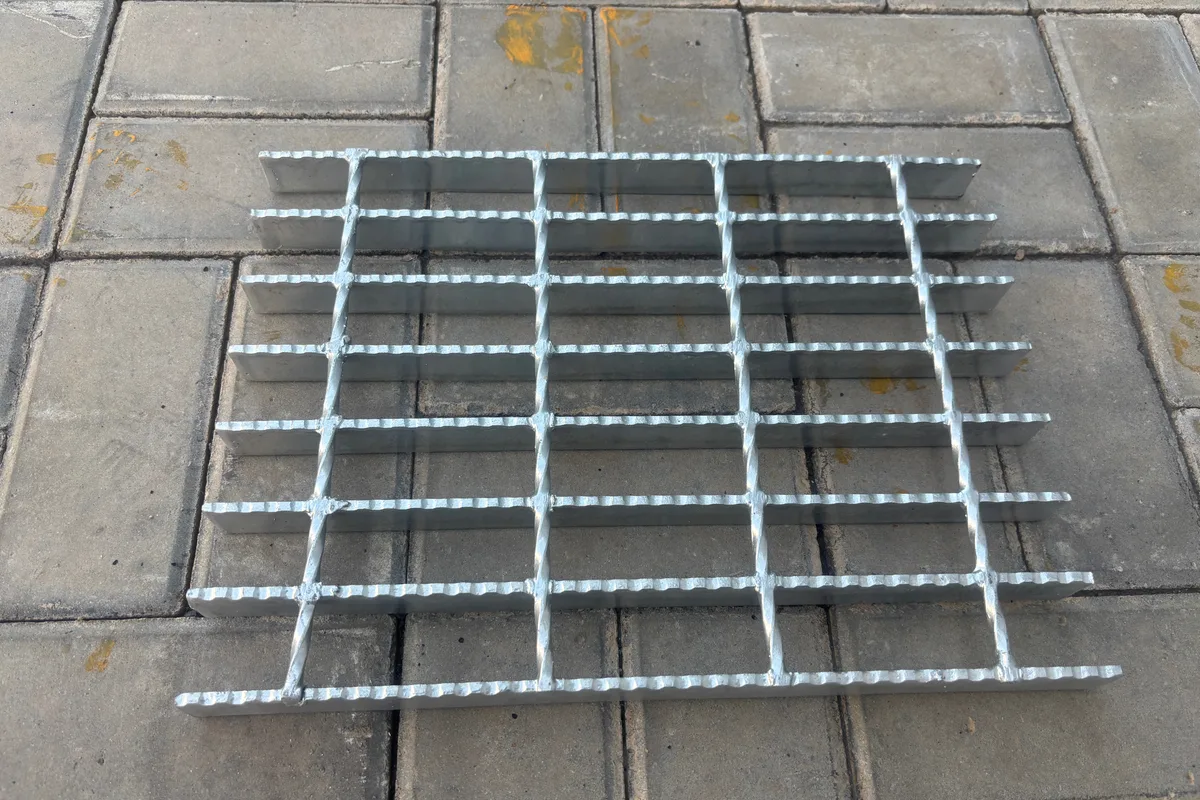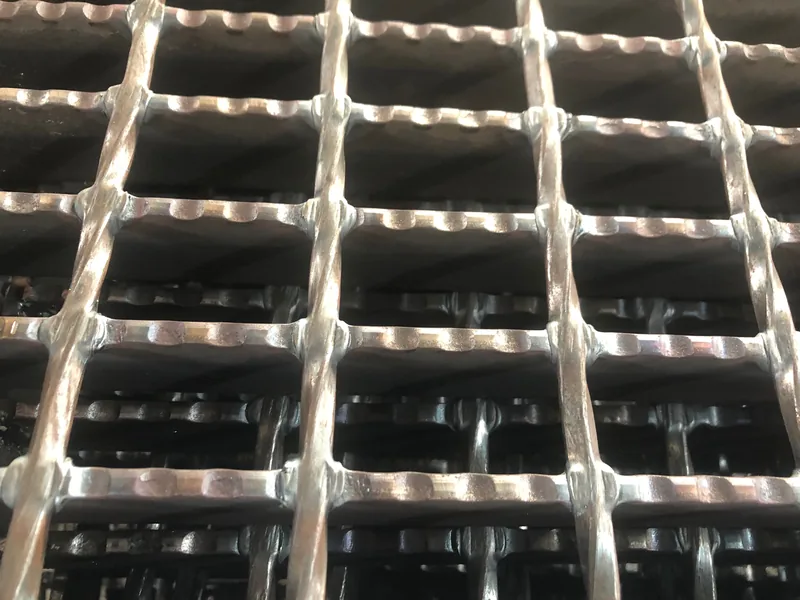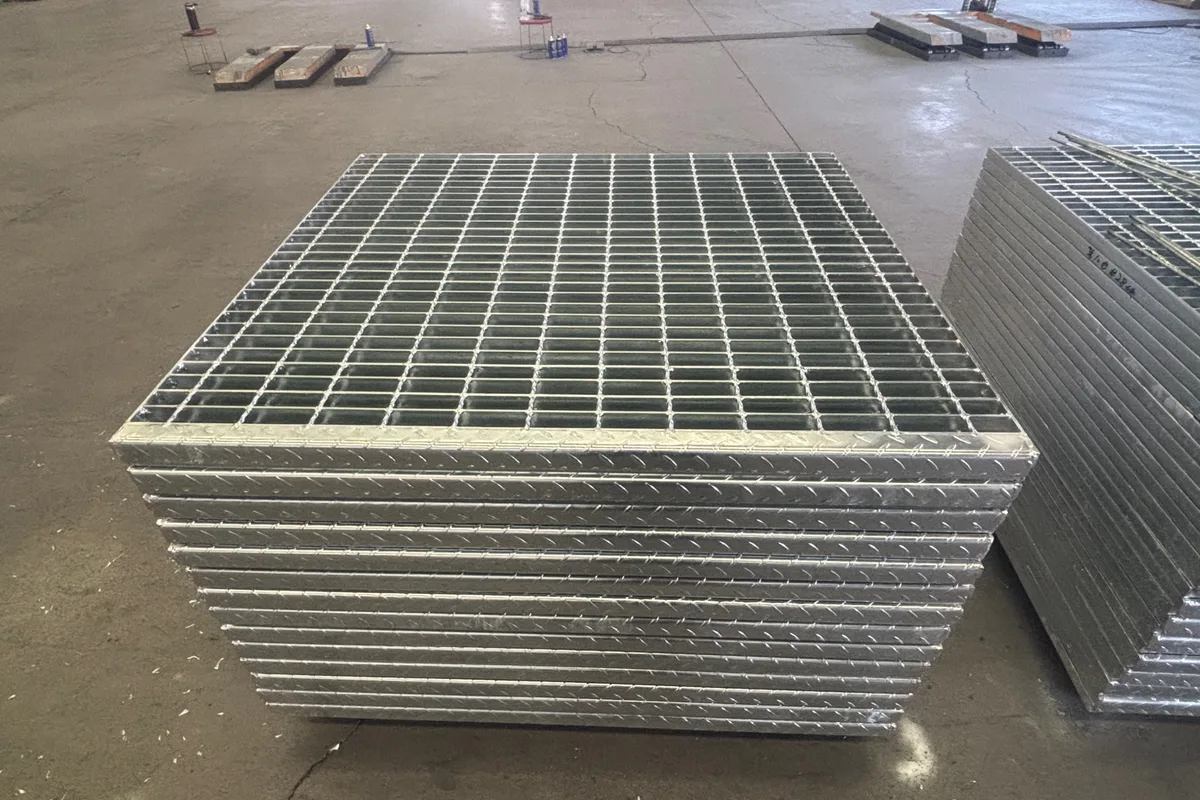
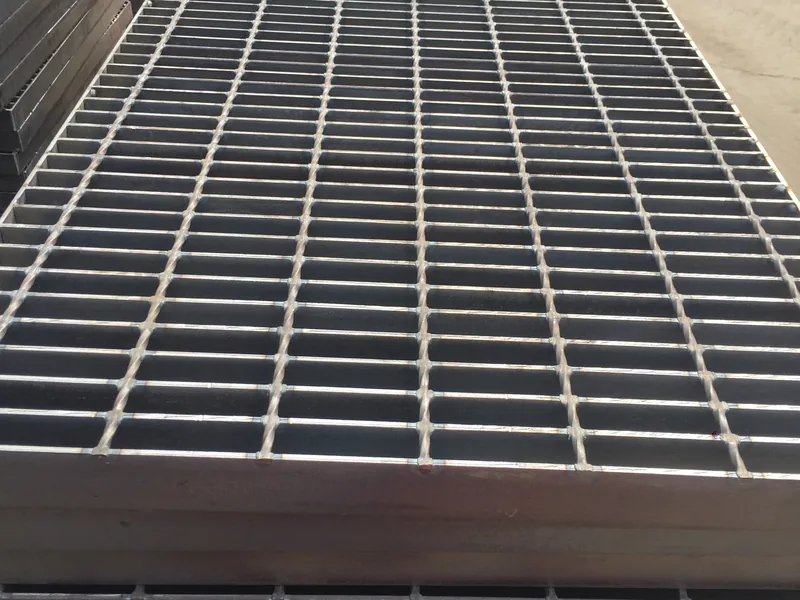
What is plain steel grating?
Plain steel grating—also called flat-top or smooth bar grating—is identical to other steel bar grating except that the top edge of the bearing bars is left flat. The only difference from serrated grating is the bar profile.
The flat surface rolls easily, is simple to clean and looks uniform, which is why it is used indoors where the floor stays dry and free of oil or contaminants.
Structure and how it works
- Bearing bars carry the load; their flat top gives the smooth walking surface.
- Cross bars hold the bearing bars in position and spread loads sideways.
- End plates or banding stiffen the panel and protect cut edges.
- Frames and cut-outs are added for covers and platforms as required.
Profile and fabrication
Plain and serrated grating are made by the same process; only the bearing-bar profile differs. For plain grating the bars are rolled or sawn flat on top. Most plain panels are then resistance-welded or press-locked, trimmed, banded and hot-dip galvanized after fabrication.
Bar preparation
Bearing and cross bars are cut, straightened and cleaned.
Profile choice
Plain (flat top) or serrated bars are selected per the slip requirement.
Joining
Bars are welded or press-locked into a one-piece grid.
Finishing
The panel is trimmed, banded and hot-dip galvanized.
Common sizes and options
| Option | Common choices | What to consider |
|---|---|---|
| Surface | Plain or serrated | Slip risk, slope and contamination |
| Bearing-bar size | 20×3 mm to 60×5 mm | Load, span and deflection |
| Bearing-bar pitch | 30 mm, 40 mm, 60 mm | Opening size and drainage |
| Finish | Hot-dip galvanized or painted | Environment and maintenance |
Surface and finish
Hot-dip galvanizing after fabrication is standard for plain carbon-steel grating. The coating reaches cut edges and welds, giving sacrificial protection even where the surface is scratched.
Applications
- Dry indoor mezzanines and equipment access floors
- Walkways and platforms in controlled environments
- Floors where trolleys, carts or rollers pass
- Architectural and decorative grids
Plain vs serrated grating
| Feature | Plain | Serrated |
|---|---|---|
| Top surface | Flat and smooth | Teeth cut into the bar top |
| Grip | Lower; slips when wet or oily | Higher; breaks the slip plane |
| Cleaning | Easier to sweep and wash | Teeth can trap finer debris |
| Use | Dry, clean, level areas | Wet, oily, sloped or outdoor |
For the full decision guide, see Plain vs Serrated Steel Grating.
Usage and installation cautions
- Do not use plain grating where the surface is wet, oily or on a slope; switch to serrated bars.
- Support the panel along the bearing bars so load reaches the primary members.
- Allow for galvanizing thickness when fitting frames, clips and removable covers.
- Touch up field cuts with zinc-rich paint on galvanized panels.
Ordering information
- Panel dimensions and clear span between supports
- Bearing-bar size, pitch and surface type
- Cross-bar pitch and finish
- Edge banding, frames, cut-outs and fixing details
- Traffic type and any contamination present
- Quantity, delivery destination and required delivery date
Plain Steel Grating FAQ
When should I choose plain over serrated?
Choose plain for dry, clean, level indoor areas where slip risk is low and easy cleaning matters.
Can plain grating be made slip-resistant later?
No. Slip resistance comes from the bar profile, so specify serrated bars at order time.
Is plain grating weaker than serrated?
No. The teeth do not add strength; both share the same load capacity for a given bar size.