
Product and selection guide
Heavy-Duty Trench Drain Grates: specification overview
“Heavy duty” is a project description, not a complete load specification. A trench grate below a slow-moving forklift, a road vehicle and a static machine may see very different wheel loads, contact areas, impact and load repetition. The governing condition must be stated.
Published grating load tables are tied to a particular bearing-bar section, bar centres, steel basis, single clear span and deflection criterion. They cannot be transferred to a different mesh or support arrangement without engineering review.
Vehicle and forklift traffic conditions
Include this detail in your drawing or enquiry for an accurate quotation.
Clear span and support arrangement
Include this detail in your drawing or enquiry for an accurate quotation.
Bearing bar direction and section
Include this detail in your drawing or enquiry for an accurate quotation.
Load data reviewed before product recommendation
Include this detail in your drawing or enquiry for an accurate quotation.
Load-case worksheet
| Input | Required project data | Why it changes the result |
|---|---|---|
| Vehicle / equipment | Type, gross mass and maximum wheel or point load | Identifies the load delivered to one panel. |
| Contact area | Tyre, wheel, foot or pad dimensions | Controls how concentrated load reaches adjacent bars. |
| Travel path | Direction, lane position, turning, braking and edge approach | May place the load at a critical panel location. |
| Frequency / impact | Occasional, repeated or continuous traffic; speed and shock | Supports fatigue and dynamic-load review. |
| Clear span | Unsupported bearing-bar span and support width | The main geometry used in capacity and deflection checks. |
| Acceptance | Required code, load factor and deflection limit | Defines the engineering pass/fail basis. |
| Frame / anchorage | Frame section, bearing seat, fixing and surrounding concrete | The support can govern even when the grate is adequate. |
Reading a load table correctly
Catalog tables commonly separate uniformly distributed load, concentrated line or point load and deflection. Each value belongs to the stated grating type and clear span. Before using a table, confirm the units, span convention, support assumption, steel basis, load location and whether the value is allowable, service or ultimate.
Details that reduce ambiguity
- Show the bearing-bar direction and every support line
- Dimension the wheel path relative to panel edges and joints
- Identify removable panels and any lifting devices
- State whether water, mud, oils or debris affect the surface
- Include frame anchorage and surrounding construction in the review
Heavy-Duty Trench Drain Grates FAQ
Can a photograph confirm heavy-duty capacity?
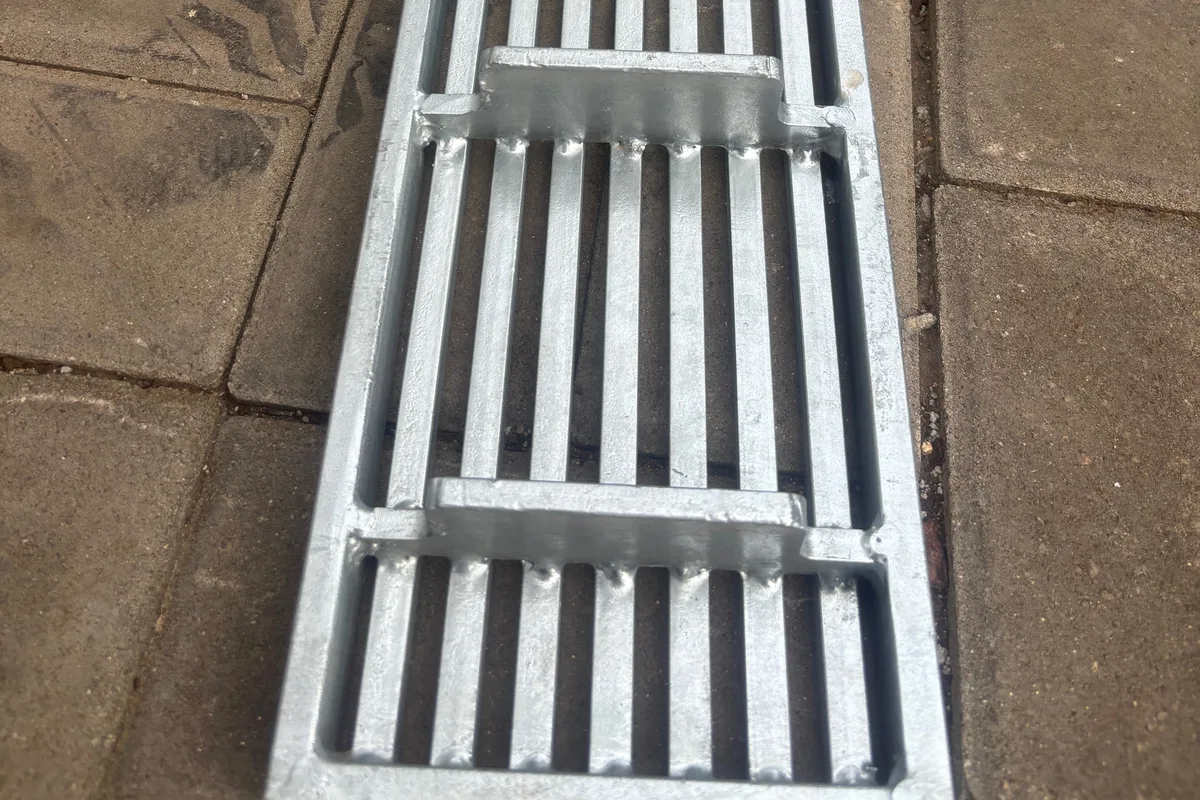
No. Similar-looking panels may have different bar sections, spacing, materials, spans and weld details.
Which load value should I send?
Send the maximum wheel, point or equipment load plus its contact area, position and frequency; include vehicle data if available.
Is the frame part of the capacity check?
Yes. Bearing seat, frame section, anchorage and surrounding concrete are part of the load path.
Technical references
Standards and terminology
- YB/T 4001.1-2019 — grating terminology and load/deflection framework
- Nucor Grating Catalog (2017) — load-table interpretation reference
State the applicable standard, edition and acceptance criteria in your enquiry. The quotation and drawing identify the agreed product configuration.
Order and drawing information
Provide dimensions, load conditions, material, finish, quantity and the applicable standard with your enquiry. The agreed details are recorded in the quotation and production drawing.